EPFL · Mechanism Design II
Balanced IsoSpring Oscillator
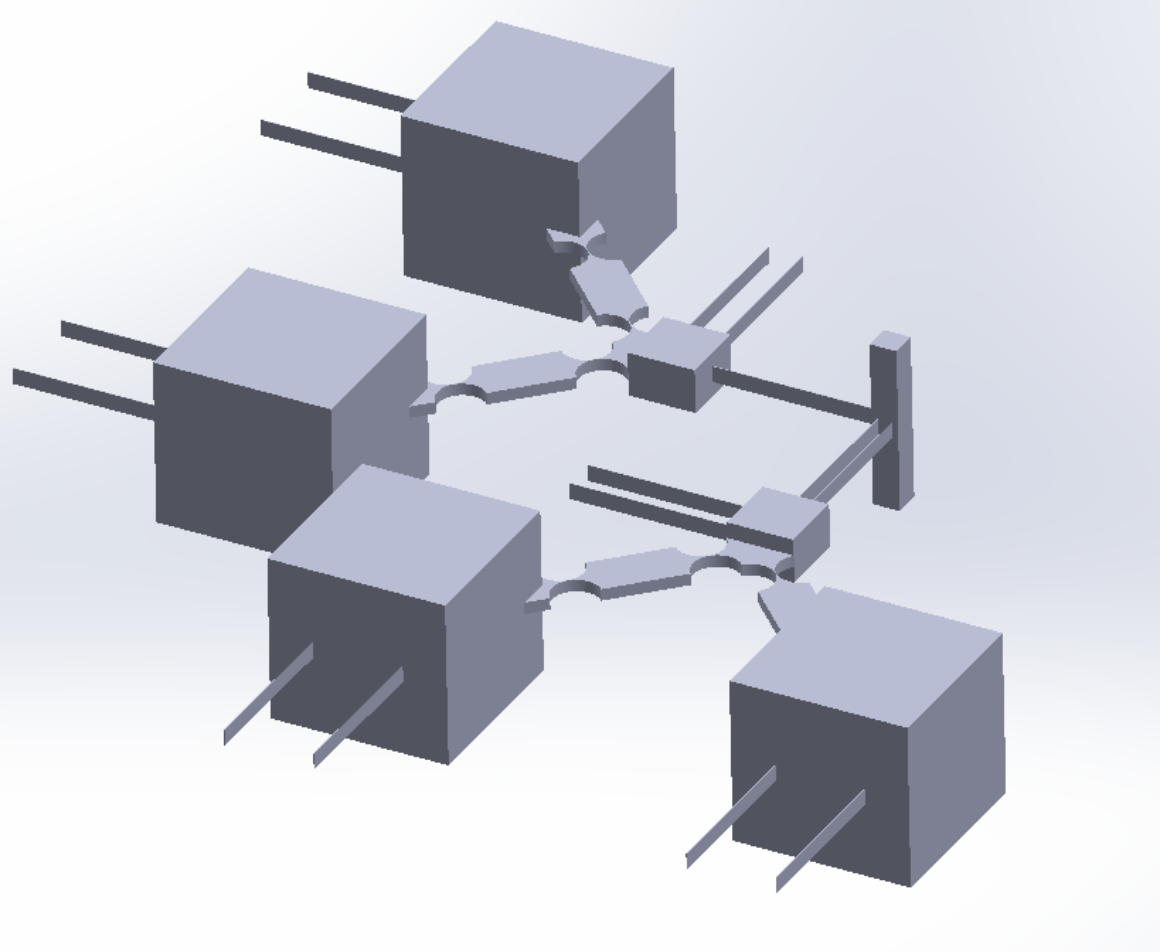
A mechanism design project at EPFL (Mechanism Design II), designed in a team of five: a portable clock module built around the IsoSpring, an oscillator concept from EPFL's Instant-Lab (2014) that removes the escapement entirely to sharply raise the resonator's quality factor Q. Two large masses oscillating along x drive a central rod, and by symmetry the tip traces an ellipse in the x-y plane, a two-degree-of-freedom isotropic oscillator.
The kinematics were verified with Grübler's mobility criterion: with 15 links, 20 single-DOF joints and b = 6 independent loops, M = Σdᵢ − 3b = 20 − 18 = 2, matching the two intended translational DOF with zero degree of hyperstatism (DOH = 0), so the mechanism is isostatic. Each ideal prismatic-plus-slider pair was then realized with compliant flexures: parallel blade tables for the guides and circular flexure necks for the connections, eliminating friction and wear.
I derived the equivalent stiffness of the flexure system by energy equivalence, summing the blade and neck contributions (kₑq,ₓ = kα/L² + 2k₀ + k₁ + k_y from the flexure formulary), which sets the oscillation frequency, and balanced the design in force and moment through opposed masses whose motions cancel, making it insensitive to gravity and to translational and rotational accelerations. The dimensioning ran through to barrel torque, orbit radius and an 8-day-plus power reserve within the imposed specification.