EPFL CV Lab
Robustness of 6D Spacecraft Pose Estimation
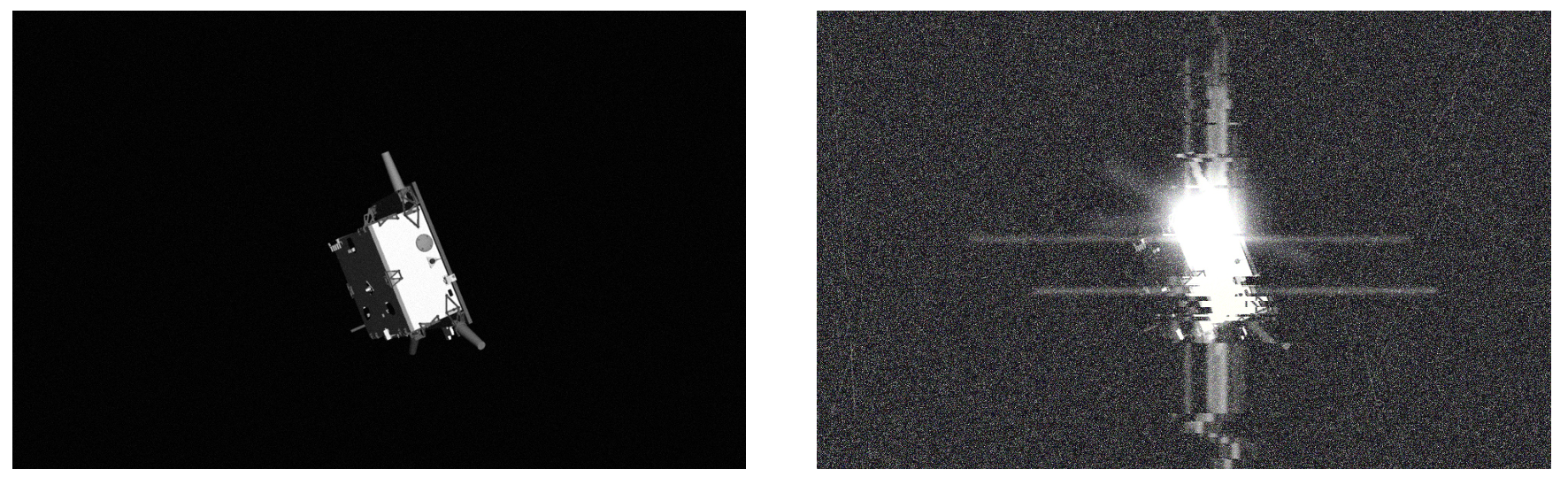
A research project with EPFL's Computer Vision Lab on the robustness of 6D spacecraft pose estimation. Orbital imagery is corrupted by optical and electronic artifacts (blooming, lens flare, dark-current noise, readout glitches) that quietly break the CNNs used for rendezvous and docking, so I built a physically grounded fault-injection pipeline to reproduce them on synthetic data.
Each fault is a parameterized module derived from its real physical cause, applied in the causal order of image formation: optical effects first, then sensor, then digital readout. Lens flare follows the Fresnel reflectance R = ((n1 − n2)/(n1 + n2))² at each air-glass interface; blooming models charge overflow once a pixel passes its well capacity Qsat = Cpixel · Vsat; dark current follows the thermal law Idark = I0 · exp(−Eg/kT); channel shift reproduces chromatic aberration through the dispersion n(λ) = n0 + A/λ². Gaussian noise and JPEG compression close the chain as residual transmission degradation.
To prove the artifacts are realistic rather than just plausible, I validated the blooming effect against real images from ESA's SPEED+ dataset with two complementary metrics: the Feature Quality Index (FQI), built from the Hamming distance between ORB descriptors of matched keypoints, and the Bhattacharyya distance between intensity histograms. On region-cropped comparisons, 90% of generated images passed both thresholds, with a mean FQI of 0.908 and histogram correlation of 0.996; a control against non-bloomed crops (correlation 0.054) confirmed the metrics were actually discriminative.