LTS5 Lab, EPFL
Ultrasound Domain Adaptation
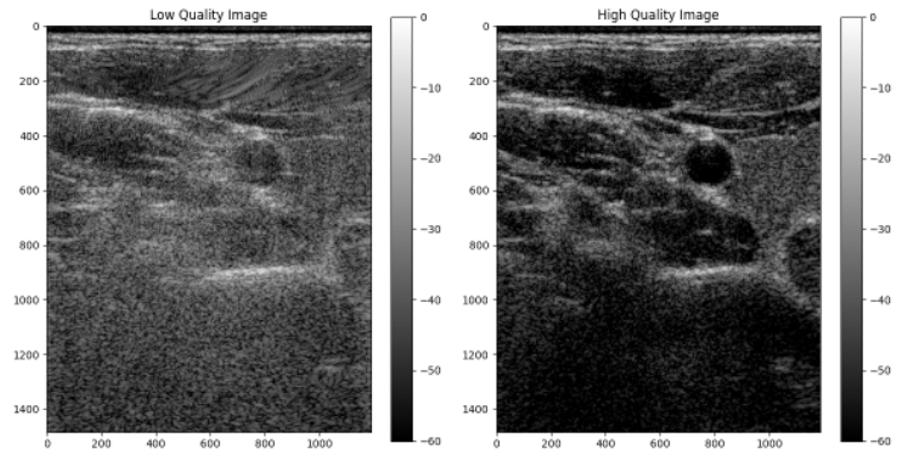
A robotics semester project at EPFL's LTS5 lab on ultrafast ultrasound (UFUS). Emitting unfocused plane waves buys very high frame rates but sacrifices image quality, so a U-Net convolutional network is trained to map a single-plane-wave acquisition at 0° (the low-quality input) onto a coherent compounding of 87 steered acquisitions (the high-quality target). The U-Net's encoder-decoder with skip connections preserves fine speckle detail while denoising, and training uses a Kullback-Leibler-divergence loss (KLD + MSLAE) that aligns the echogenicity probability distributions rather than only pixel error.
The core problem is domain shift: a CNN trained on one probe (GE 9L-D at 5.3 MHz) degrades on images from another (GE 11L-D at 7.3 MHz) because resolution, noise and dynamic range differ. I addressed it with transfer learning, fine-tuning a pretrained network on a small subset of the target domain under a strict volunteer-based split so no subject leaks between train, validation and test.
I compared fine-tuning strategies (freezing the encoder, gradient-based selection, and alternating frozen/trainable layers). Alternating freezing with a step of 4 layers won, reaching PSNR 15.59 and SSIM 0.0952, a relative gain of 11.69% in PSNR and 52.32% in SSIM over baseline, and the output echogenicity histogram was restored to match the high-quality target in both shape and range.